

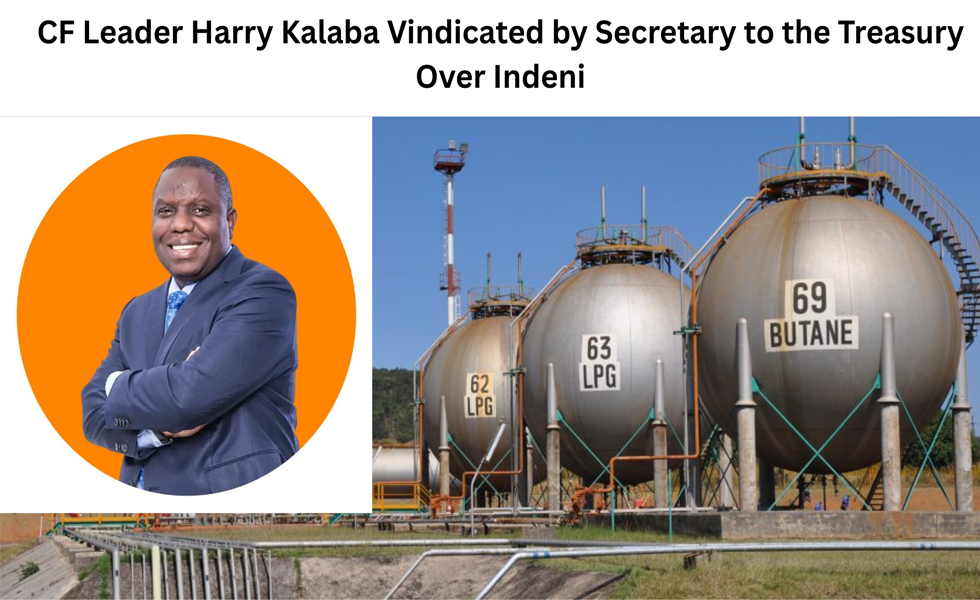
CF Leader Harry Kalaba Vindicated by Secretary to the Treasury Over Indeni
By the Independent Business and Economic Correspondent
Wednesday, 1st April, 2026
In a striking turn of events that is likely to reshape debate around Zambia’s energy sector, Secretary to the Treasury Felix Nkulukusa has openly questioned the government’s decision to transition Indeni Energy Limited from an oil refinery into a fuel trading entity. Effectively re-echoing long-standing concerns raised by Citizens First (CF) leader Harry Kalaba.
Appearing before the Parliamentary Committee on Parastatal Bodies on Tuesday, Nkulukusa delivered a candid assessment that many observers interpret as a tacit admission that critics like Kalaba were right all along.
“Obviously, our feeling from the Treasury or my feeling, is that probably Indeni should be repurposed. They cannot do fuel trading,” Nkulukusa stated. “Fuel needs enormous resources, not only in buying the fuel itself but investment in human technology.”
His remarks mark one of the clearest acknowledgments yet from within government ranks that the strategic shift at Indeni may have been fundamentally flawed.
A Policy Under Fire
The decision to transform Indeni into a fuel marketing company was initially framed as a modernization effort aimed at improving efficiency and aligning Zambia with global energy market trends. However, Kalaba and other critics consistently argued that the move underestimated the financial and technical demands of fuel trading.
Now, Nkulukusa’s admission adds significant weight to those criticisms.
In unusually frank language for a senior Treasury official, he went further to describe the transition as “regrettable,” noting that, with the benefit of hindsight, it is a decision that would not have been made.
“If time could be reversed, such a move would not have been allowed,” he said.
Financial Reality Bites
At the heart of the issue lies a stark fiscal reality: fuel trading is a capital-intensive business that requires deep financial reserves, sophisticated logistics systems, and highly specialized expertise. According to Nkulukusa, the Zambian government simply does not have the capacity to adequately fund such an operation at the scale required.
This directly aligns with Kalaba’s earlier warnings that the shift would stretch public resources and risk undermining the viability of the state-owned enterprise. Had the state taken time to listen to the CF leader, a lot of the challenges we are facing in the energy sector today could have easily been avoided.
Nkulukusa emphasized that beyond the cost of procuring fuel, successful trading demands sustained investment in technology, skilled personnel, and risk management frameworks, areas where Indeni is currently ill-equipped.
Calls for Repurposing
The Treasury’s position now appears to favor a strategic pivot towards the CF leaders position. Rather than continuing on the current path, Nkulukusa suggested that Indeni should be repurposed into a role better suited to its capabilities.
While specific alternatives were not outlined, the implication is clear: maintaining the status quo is no longer tenable.
Political Implications
For Harry Kalaba, this development represents a significant moment of political validation. His earlier criticism of the Indeni transition, once dismissed by some as opposition rhetoric, now finds support in the government’s own financial leadership.
The episode underscores a broader lesson about policy formulation in critical sectors such as energy: ambitious reforms must be grounded in realistic assessments of capacity and resources.
Looking Ahead
As Zambia grapples with energy security challenges and fiscal constraints, the future of Indeni remains uncertain. What is clear, however, is that the conversation has shifted, towards Harry Kalaba’s view.
With the Treasury now openly acknowledging the shortcomings of the current model, pressure is likely to mount on policymakers to chart the CF course, one that balances ambition with practicality.
For many observers, the question is no longer whether the transition was a mistake, but how quickly and effectively the government can correct it.