
By the Independent Political Correspondent
Monday, 10th August, 2026
There is imitation, and then there is intellectual surrender. What is unfolding at the Electoral Commission of Zambia (ECZ) increasingly looks like the latter – a troubling attempt to import electoral practices wholesale from Tanzania without regard for Zambia’s own legal framework, electoral traditions, or constitutional safeguards.
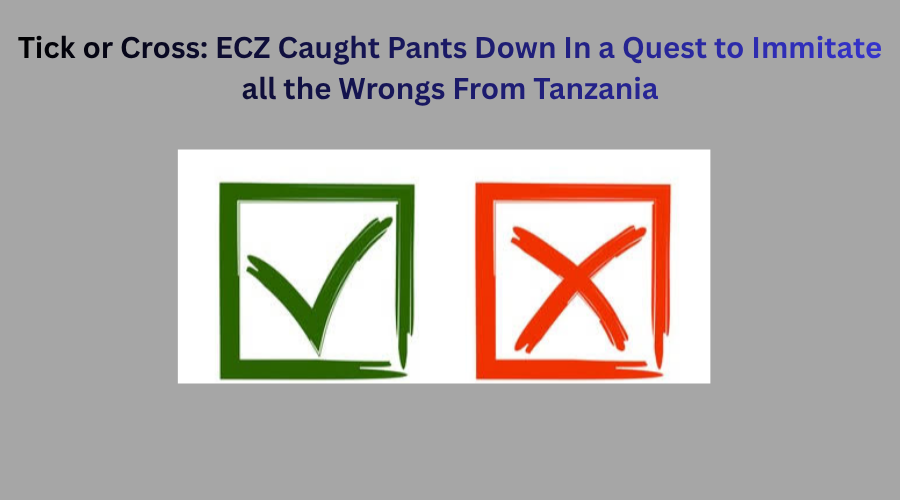
At the centre of the controversy is the pronouncement by the ECZ’s own chief elections officer—that voters may use either a tick or a cross when casting their ballots in the upcoming August 13, 2026 elections. On the surface, this may appear administrative, even harmless. But in a country governed by law—not improvisation—such a shift raises profound legal and political questions.
Zambia is not a laboratory for borrowed electoral experiments. It is a sovereign republic with established statutes that guide how elections must be conducted. Deviating from those statutes, especially on something as fundamental as how a vote is marked and counted, is not innovation—it is illegality.
What is most concerning is not merely the borrowing itself, but the careless manner in which it appears to have been done. This is not policy adaptation; it resembles the work of a “dull student” who, in copying another’s answer sheet, goes so far as to replicate the name at the top—an act that betrays not just laziness, but a complete lack of understanding.
The ECZ’s apparent willingness to mirror Tanzania’s “tick or cross” system—without clear legal grounding—opens the floodgates to electoral disputes. In a political climate already charged with tension, allegations, and sporadic violence, such ambiguity is reckless. It risks giving aggrieved parties a legitimate basis to reject election outcomes, thereby undermining public trust in the entire democratic process.
And that is the deeper danger: this is not just about how a ballot is marked. It is about whether the electoral body is acting within the law or bending it to suit unseen interests.
Critics have begun to question whether this move is part of a broader pattern involving the ruling United Party for National Development (UPND), raising concerns about the independence of the ECZ. While such claims require careful scrutiny, the Commission’s actions are doing little to inspire confidence.
At a time when Zambia needs a steady, impartial referee, the ECZ appears instead to be experimenting with the rulebook mid-game.
One would have expected a more measured, legally grounded approach—particularly in an election cycle already marred by noise, tension, and violence. Electoral bodies are meant to calm storms, not stir them.
The implications are serious. If the ECZ proceeds with this approach and accepts ballots marked in ways not clearly sanctioned by Zambian law, it may inadvertently—or deliberately—create grounds for post-election disputes. In such a scenario, the credibility of the results could collapse under the weight of legal challenges.
This is why opposition leaders must act—not with rhetoric, but with urgency and precision. The courts exist precisely for moments like this. Immediate judicial intervention is not only appropriate; it is necessary. Clarification must be sought now, before ballots are cast, not after the country is plunged into a crisis of legitimacy.
But beyond the courts and political actors, there is another institution whose role must be clearly understood and firmly upheld: the defence forces.
There are growing murmurs—quiet but persistent—about possible plans to deploy the military in ways that could intimidate voters before, during, or after the elections. Whether these concerns materialise or not, the principle must be stated unequivocally.
The duty of the armed forces is not to any political party, nor to any administration of the day. It is to the Constitution and to the people of Zambia. That duty includes protecting the nation against all threats—foreign and domestic. And history has shown, time and again, that threats to democracy do not always come from outside the borders; sometimes they emerge from within, cloaked in authority but driven by self-preservation.
Members of the defence forces must remember this: your loyalty is to the Republic, not to individuals who may seek to manipulate institutions to retain power. Any instruction that compromises the integrity of the electoral process is not just questionable—it is incompatible with your oath.
Zambia stands at a delicate moment. The choices made now—by the ECZ, by political leaders, by the judiciary, and by state institutions—will determine whether the country strengthens its democratic foundations or erodes them.
Copying another country’s electoral system without legal basis is not reform. It is regression.
And Zambia, for all its challenges, deserves better than to be reduced to a nation that copies answers without understanding the questions.